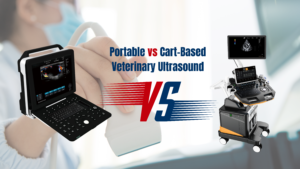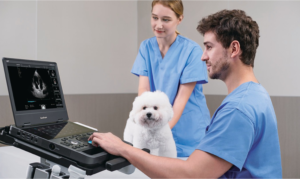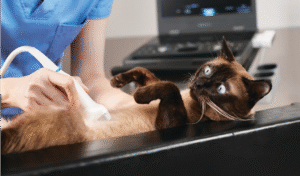
Veterinary ultrasound buyers usually don’t search “Cart-Based vs Portable Veterinary Ultrasound” out of curiosity.
They search because they face real clinical decisions:
→ Why does image quality feel different between systems?
→ Do I really need a cart-based unit, or is it portable enough?
→ How do daily caseload, clinic size, and workflow affect the choice?
→ Is the higher price of a cart-based system clinically justified?
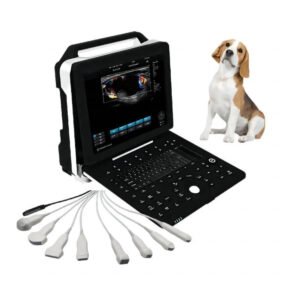
This guide answers those questions clearly and practically, using the examples of mainstream portable and cart-based systems (such as the APV-P8 and APV-T8).
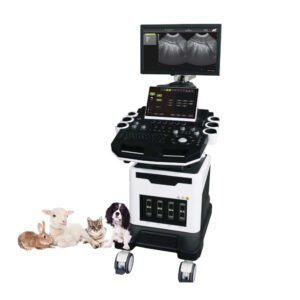
Why Cart-Based Ultrasound Still Delivers Better Image Quality
Many veterinarians intuitively feel that cart-based systems image better, and that instinct is correct.
The advantage is hardware architecture, not branding.
Processing Power and Thermal Capacity
Cart-based systems are physically larger, allowing them to integrate:
✓ More powerful CPUs and GPUs
✓ Dedicated image reconstruction chips
✓ Larger heat dissipation systems
Advanced ultrasound processing is computationally intensive, especially for:
✓ Color Doppler & Power Doppler
✓ Tissue Harmonic Imaging (THI)
✓ Speckle reduction and edge enhancement
Example: APV-T8 (cart-based) can continuously process Doppler data at high frame rates without throttling and maintain image stability during long sessions.
APV-P8 (portable), while highly capable, must balance performance with battery life, size, and heat dissipation.
Clinical result:
| Feature | APV-P8 Portable | APV-T8 Cart-Based |
|---|---|---|
| Image stability | Good for routine scans | Superior for prolonged/complex scans |
| Doppler performance | Excellent | High-frame-rate, high-sensitivity, more stable |
Cart-based systems support:
✓ Higher transmit power
✓ More simultaneous channels
✓ Larger and more specialized probes
Impact in practice:
✓ Deeper abdominal organs
✓ Large or obese animals
✓ Advanced reproductive or cardiac cases
Key Parameters:
| Feature | APV-P8 | APV-T8 |
|---|---|---|
| Max scanning depth | ≈360 mm | ≈410 mm |
| Dynamic range | ≥180 dB | ≈300 dB |
| Probe interfaces | ≥2 active | ≥4 fully activated |
| Display | 15-inch LCD | 21.5–23.8 inch LCD + touchscreen |
Higher dynamic range enables finer differentiation between soft tissues. Greater scanning depth improves penetration in large dogs, deep abdomen, or obese patients.
Advanced Functions Typically Found on Cart-Based Systems
Cart-based systems usually include more advanced tools because they serve high-volume or specialized clinics:
▸ Full-spectrum Color Doppler with higher sensitivity
▸ Power Doppler for low-velocity blood flow
▸ Multi-angle compound imaging
▸ Advanced cardiac measurement packages
▸ Larger cine loop memory and long-term storage
Clinical value: referral clinics, cardiology or reproductive specialists, teaching hospitals.
APV-T8 is designed as a central diagnostic workstation; portable systems like APV-P8 are optimized for flexibility.
Why Some Veterinarians Prefer Cart-Based Ultrasound (Habit Matters)
Beyond technical specs, workflow and habit influence choice. Many vets trained on cart-based systems value:
✓ Large monitors (21–23 inch)
✓ Stable console and probe holders
✓ Dedicated scanning rooms
✓ Consistent ergonomics
Even if a portable system is capable, muscle memory and comfort reduce fatigue during long scan sessions.
This is especially common in:
• Established clinics
• Senior practitioners
• Clinics with dedicated ultrasound rooms
When Portable Ultrasound Is the Smarter Choice
Portable systems like APV-P8 excel when flexibility outweighs maximum imaging depth:
▸ Small clinics with limited space
▸ General practices performing routine scans
▸ Point-of-care diagnostics
▸ Clinics without a dedicated ultrasound room
Advantages:
✓ Immediate availability during consultations
✓ Easy room-to-room movement
✓ Lower upfront investment
✓ Short learning curve for general practitioners
For many clinics, portable ultrasound is the primary daily diagnostic tool, not a secondary device.
Cost Comparison: Realistic Investment Ranges
Budget matters. Typical market ranges:
| System Type | Cost (USD) |
|---|---|
| Portable (APV-P8) | 20,000 – 40,000 |
| Cart-Based (APV-T8) | 25,000 – 45,000 |
*Costs vary depending on probe types, software modules, and warranty options.
The difference reflects:
• Hardware power and processing capability
• Display size and ergonomics
• Advanced imaging modules
• Clinical workload capacity
Choosing a cart-based system for a clinic performing occasional scans may lead to underutilization. Choosing portable ultrasound for a high-volume clinic may cause workflow fatigue.
Practical Clinical Decision Framework
Daily Caseload
• >10 scans/day → Cart-based recommended
Stable operation, larger screen, less operator fatigue
• <10 scans/day → Portable usually sufficient
Clinic Size & Layout
• Large clinic with multiple rooms → Portable offers flexibility
• Dedicated ultrasound room → Cart-based integrates well
Type of Practice
• General / routine diagnostics → Portable systems (APV-P8)
• Referral / reproductive / cardiology focus → Cart-based (APV-T8)
Summary Table
| Feature | APV-P8 Portable | APV-T8 Cart-Based |
|---|---|---|
| Structure | Compact, lightweight | Dual-screen, full cart |
| Image Quality | High-resolution, routine scans | Superior 2D/3D, advanced Doppler, deeper penetration |
| Advanced Functions | Color Doppler, THI, B/C/D synchronous imaging | All portable features + enhanced spectral Doppler, real-time 3D/4D, contrast imaging |
| Ergonomics | Easy to move | Stable, comfortable for long sessions |
| Daily Caseload | <10 scans/day | >10 scans/day |
| Clinic Size | Small, shared rooms | Large, dedicated ultrasound rooms |
| Max Scanning Depth | ≈360 mm | ≈410 mm |
| Dynamic Range | ≥180 dB | ≈300 dB |
| Display | 15-inch LCD | 21.5–23.8 inch LCD + touchscreen |
| Cost | USD 20,000–40,000 | USD 25,000–45,000 |
FAQ – Frequently Asked Questions
Final Perspective: Right System = Used Well
The best ultrasound system is not the most expensive or the most compact.
It is the one that:
✓ Fits the clinic’s daily rhythm
✓ Matches the veterinarian’s habits
✓ Supports accurate diagnosis without friction
Portable and cart-based ultrasound systems are tools designed for different realities, not competitors. Understanding your clinic’s workflow, patient volume, and diagnostic needs ensures confident purchasing decisions—and better patient care.