
Choosing a veterinary ultrasound machine has become more challenging than ever.
New portable systems, improved imaging technology and a wider range of suppliers mean buyers have more options—but also more decisions to make.
Ultrasound equipment is usually a long-term investment. The system you choose will influence:
- daily clinical workflow,
- examination efficiency,
- diagnostic capability,
- future service development.
With more veterinary ultrasound options available today, buyers often face a difficult question:
How do you choose the right system without paying for features you may not use?
The answer is not simply choosing the machine with the highest specifications.
A suitable veterinary ultrasound system should match:
- the type of animals you examine,
- the clinical services you provide,
- how frequently the equipment is used,
- your future development plans.
In practice, experienced buyers often find that the most suitable system is not always the one with the longest feature list, but the one that fits their real working environment.
This guide explains the key factors to consider when choosing a veterinary ultrasound machine in 2026, from clinical applications and probe selection to cost, supplier support and distributor considerations.
Quick Buyer’s Checklist
Before comparing different veterinary ultrasound machines, ask yourself these questions:
✓ Which animal species do I examine most frequently?
✓ Do I need portability or a dedicated examination room?
✓ Which probes will I use every day?
✓ Is Doppler necessary for my clinical services?
✓ What level of after-sales support do I expect?
✓ Will my practice expand in the next three to five years?
If you can answer these questions first, choosing the right veterinary ultrasound system becomes much easier.
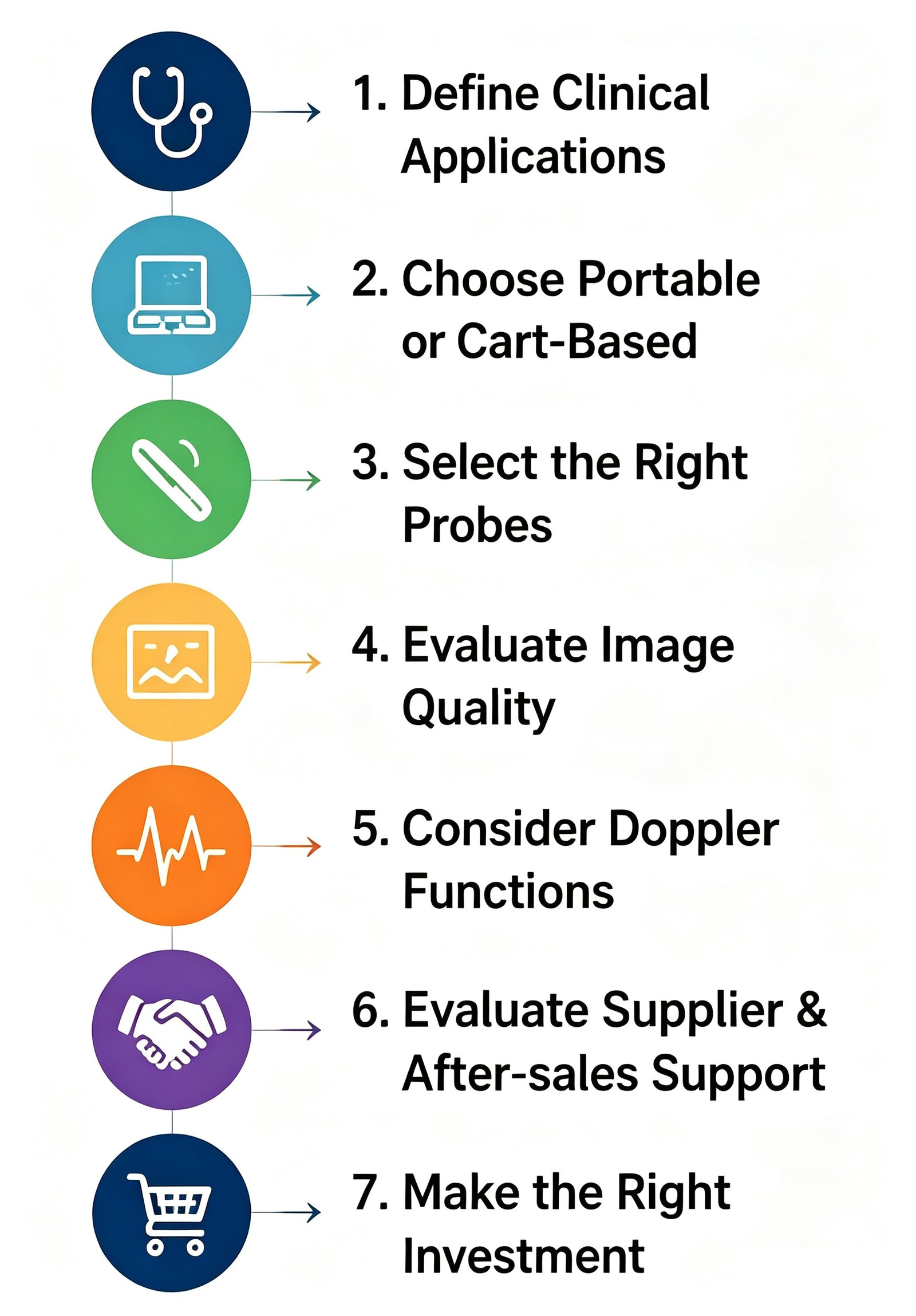
In this guide, you’ll learn how to evaluate clinical applications, probe selection, image quality, Doppler functions, supplier reliability and long-term investment value before purchasing a veterinary ultrasound machine.
12 Questions Buyers Should Ask Before Choosing a Veterinary Ultrasound Machine
Before investing in veterinary ultrasound equipment, buyers should consider the following questions:
1. What Clinical Applications Will the Ultrasound System Support?
The first step is understanding how the equipment will actually be used.
Different veterinary professionals have different priorities.
A small animal clinic may mainly require ultrasound for:
- abdominal scanning,
- pregnancy diagnosis,
- urinary examination,
- emergency assessment.
An equine veterinarian may focus more on:
- tendon imaging,
- reproductive examinations,
- musculoskeletal applications.
A referral hospital may require:
- cardiac imaging,
- Doppler evaluation,
- advanced diagnostic functions.
The most suitable ultrasound system starts with clinical requirements, not product specifications.
Choosing Veterinary Ultrasound Based on Animal Applications
Small Animal Ultrasound Applications
For companion animal practices, ultrasound is commonly used for:
- abdominal organs,
- liver and spleen evaluation,
- kidney and bladder examination,
- pregnancy monitoring,
- soft tissue assessment.
A flexible configuration with suitable probes can support a wide range of routine examinations.
For many small animal clinics, selecting the right probe combination is often more important than choosing the most advanced software package.
Equine Ultrasound Applications
Equine veterinarians often require equipment suitable for:
- tendon examination,
- ligament assessment,
- reproductive scanning,
- field applications.
High-resolution imaging and practical portability are important considerations.
For mobile equine professionals, the ability to bring reliable equipment directly to the patient can be a major advantage.
Farm Animal Ultrasound Applications
Farm animal veterinarians often work in challenging environments.
Important factors include:
- portability,
- durability,
- efficient workflow,
- easy cleaning,
- reliable performance.
Equipment designed for field applications should focus on practical daily use.
2. Should You Choose a Portable or Cart-Based Veterinary Ultrasound Machine?
One of the most common questions buyers ask is:
“Should we choose a portable veterinary ultrasound system or a cart-based ultrasound machine?”
The answer depends on your workflow.
Neither option is automatically better.
The right choice depends on:
- where the system will be used,
- how frequently it needs to be moved,
- what examinations are performed,
- available space,
- future requirements.
Portable Veterinary Ultrasound Systems
Portable veterinary ultrasound systems have become increasingly popular because of their flexibility.
They are often selected by:
- mobile veterinarians,
- small animal clinics,
- mixed practices,
- field professionals.
Advantages include:
✓ Easy transportation
✓ Flexible use between locations
✓ Lower space requirements
✓ Suitable for mobile applications
✓ Faster setup during examinations
Modern portable systems can support many professional veterinary applications.
However, buyers should still evaluate whether the system provides the required image quality and probe options for their intended use.
Cart-Based Veterinary Ultrasound Systems
Cart-based ultrasound systems remain widely used in:
- veterinary hospitals,
- referral centres,
- teaching institutions.
Their advantages may include:
- larger displays,
- ergonomic operation,
- multiple probe connections,
- advanced workflow features.
For high-volume clinical environments, these benefits may justify the additional investment.
Practical Comparison: Portable vs Cart-Based Ultrasound
| Consideration | Portable Ultrasound | Cart-Based Ultrasound |
|---|---|---|
| Mobility | Excellent | Limited |
| Space requirement | Lower | Higher |
| Field use | Very suitable | Less practical |
| Display size | Compact | Larger |
| Mobile veterinary work | Strong advantage | Limited |
| Hospital workflow | Suitable | Often preferred |
The goal is not to select the most advanced format.
The goal is to select the system that supports the way your team works every day.
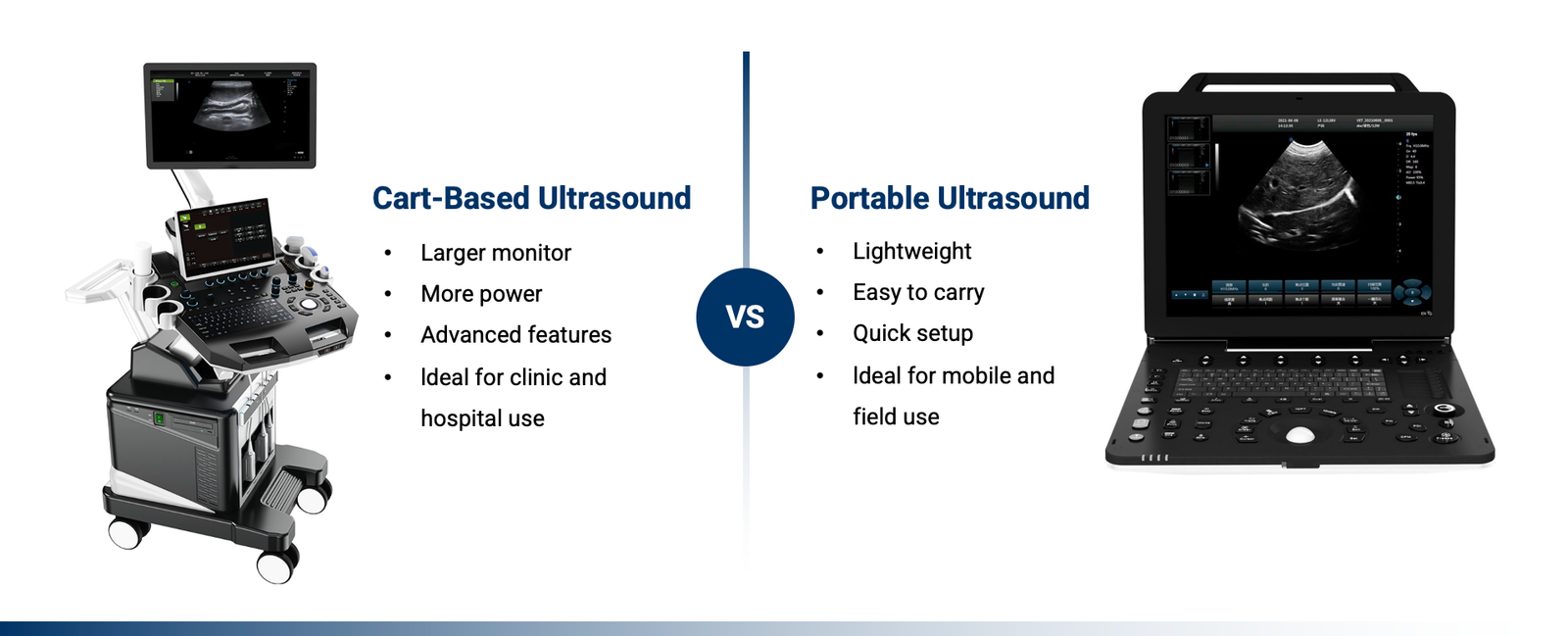
Choosing between portable and cart-based ultrasound systems depends on mobility requirements, clinical workflow and examination environments. Explore the differences between the two system types in our detailed comparison.
Read: Portable vs Cart-Based Veterinary Ultrasound – Which Is Right for Your Practice?
3. Which Veterinary Ultrasound Probes Do You Really Need?
When buyers compare veterinary ultrasound machines, attention often goes to image quality, software features or Doppler capabilities.
However, one of the most important decisions is often much simpler:
Which probes do you actually need?
The probe determines which examinations can be performed comfortably and efficiently. Choosing the right probe combination often has a greater impact on daily clinical work than selecting additional software features.
Rather than asking:
“Which system supports the most probes?”
A better question is:
“Which probe combination best matches the animals and examinations we perform every day?”
For most veterinary practices, it is neither necessary nor cost-effective to purchase every available probe from the beginning. Starting with the probes used most frequently and expanding later is often a more practical approach.
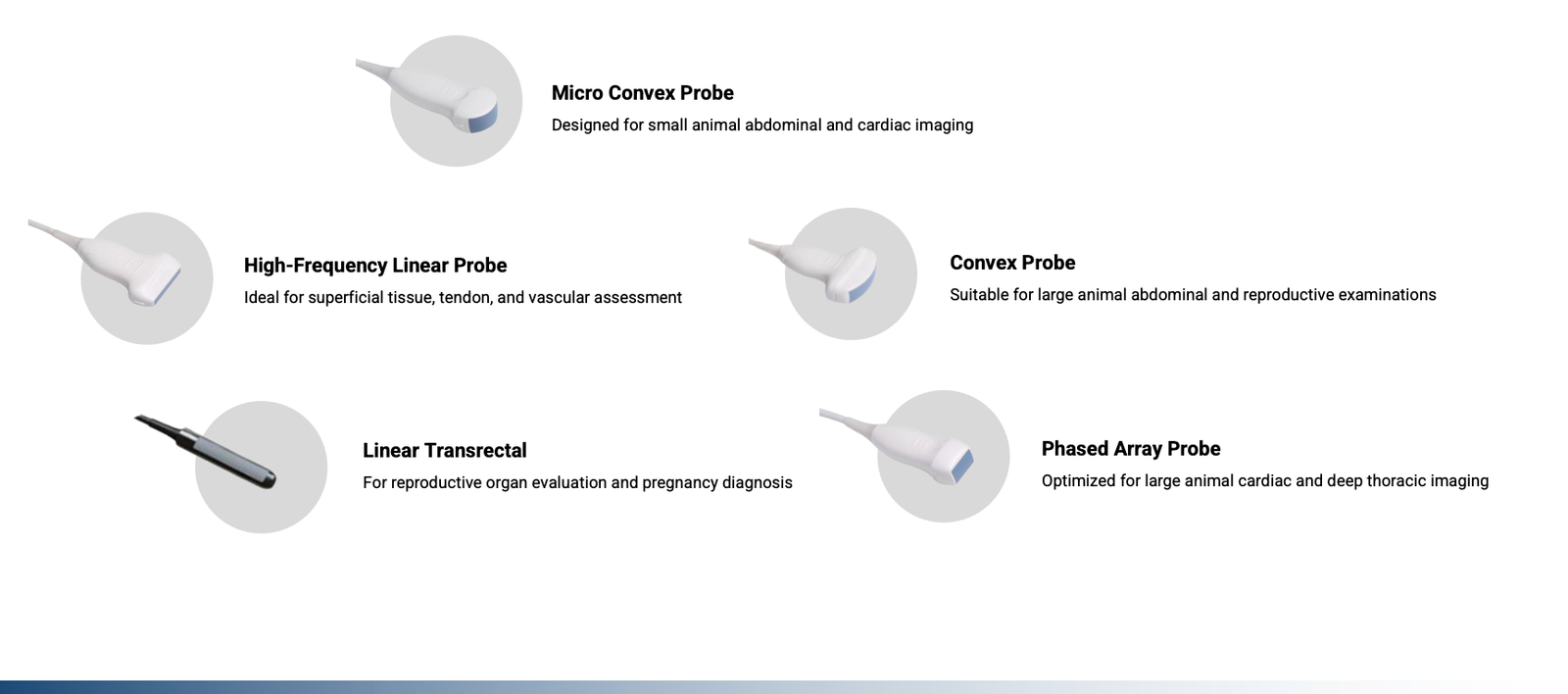
Microconvex Probe – The First Choice for Many Companion Animal Practices
For many veterinary clinics treating mainly cats and dogs, the microconvex probe is often the preferred starting point.
Its compact footprint makes it easier to position between ribs and on smaller patients, while still providing sufficient penetration for routine abdominal examinations.
Typical applications include:
- Abdominal examinations
- Pregnancy diagnosis
- Urinary tract assessment
- Liver and spleen evaluation
- Kidney examinations
- Routine scans in cats and dogs
Because companion animals represent the majority of daily cases in many European veterinary practices, a microconvex probe is often the most frequently used transducer.
For many clinics, if only one probe is purchased initially, a microconvex probe is usually the most versatile option.
Linear Probe – Essential for High-Resolution Superficial Imaging
A linear probe provides high-resolution images of structures located close to the skin surface.
It is commonly used for:
- Tendons and ligaments
- Musculoskeletal examinations
- Superficial masses
- Thyroid and soft tissue evaluation
- Vascular assessment
In equine practice, linear probes are widely used for tendon and ligament imaging.
In companion animal practice, they are frequently selected alongside a microconvex probe to create a versatile daily scanning setup.
For many clinics, Microconvex + Linear is one of the most practical probe combinations.
Convex Probe – A Good Choice for Larger Patients and Deeper Structures
Compared with a microconvex probe, a convex probe generally offers a wider field of view and greater penetration.
It is commonly chosen for:
- Large dogs
- Farm animals
- Equine reproductive examinations
- Deep abdominal imaging
While convex probes remain an important option, they are not always the first choice for clinics that mainly treat companion animals.
Their value becomes more apparent when examining larger patients or when additional penetration is required.
Linear Transrectal Probe – Essential for Bovine and Equine Reproduction
For veterinarians specialising in cattle or equine reproduction, a linear transrectal probe is one of the most important specialised transducers.
Its long, slim design allows reproductive examinations to be performed safely and efficiently in large animals.
Typical applications include:
- Pregnancy diagnosis
- Ovarian examinations
- Follicle monitoring
- Uterine evaluation
- Reproductive management in cattle
- Reproductive examinations in horses
If reproductive work is an important part of your practice, confirm that the ultrasound system supports a compatible linear transrectal probe before making a purchase.
Phased Array Probe – Designed for Cardiac Ultrasound
Cardiac ultrasound presents different challenges from routine abdominal imaging.
Because the heart is constantly moving and examined through relatively narrow acoustic windows, a phased array probe is the preferred choice for veterinary echocardiography.
Typical applications include:
- Echocardiography
- Cardiac screening
- Colour Doppler examinations
- Cardiac function assessment
Practices that regularly perform cardiac examinations should ensure that the ultrasound system supports both a phased array probe and the Doppler functions required for their clinical workflow.
Recommended Probe Configurations
There is no single probe combination that suits every veterinary practice.
The most appropriate configuration depends on the species you treat and the examinations you perform most frequently.
| Practice Type | Recommended Probe Configuration | Typical Applications |
|---|---|---|
| Companion animal clinic | Microconvex + Linear | Routine examinations for cats and dogs |
| Mixed animal practice | Microconvex + Linear + Convex | Companion animals plus occasional large animal work |
| Mobile companion animal veterinarian | Microconvex | Routine examinations during mobile or home visits |
| Equine practice | Linear + Convex (add a Linear Transrectal probe for reproduction work) | Tendon, musculoskeletal, abdominal and reproductive imaging |
| Bovine reproduction practice | Linear Transrectal + Convex | Pregnancy diagnosis and reproductive management |
| Cardiology-focused practice | Phased Array + Microconvex | Cardiac examinations plus routine abdominal imaging |
Practical Buying Advice
Choosing the right probe combination is often more important than choosing the ultrasound system with the longest feature list.
For many companion animal clinics, starting with a microconvex and linear probe provides excellent day-to-day versatility. Mixed animal practices can add a convex probe for larger patients, while reproductive specialists and cardiology practices should select dedicated probes that match their clinical services.
As your practice grows, additional probes can usually be added later, allowing your ultrasound system to expand alongside your clinical needs.
Looking for a portable veterinary ultrasound system? Explore our ultrasound range and compare available probe configurations for companion animal, equine and mixed practices.
4. What Image Quality Factors Actually Matter?
When comparing veterinary ultrasound machines, buyers often see marketing terms such as:
- advanced imaging technology,
- high-definition ultrasound,
- intelligent optimisation,
- superior resolution.
However, professional buyers know that image quality should be evaluated from a clinical perspective.
The most impressive specification sheet does not always represent the best daily scanning experience.
Resolution Is Important, But Not the Only Factor
Higher resolution can help identify smaller structures.
However, practical image quality also depends on:
- tissue differentiation,
- image stability,
- penetration depth,
- processing speed,
- operator experience.
The goal is not simply to produce the sharpest image.
The goal is to provide reliable information that supports clinical decisions.
Penetration Depth and Patient Size
Veterinary ultrasound involves patients of very different sizes.
A system may be used for:
- cats,
- small dogs,
- large dogs,
- horses,
- livestock.
Different patient sizes create different imaging challenges.
A suitable veterinary ultrasound system should provide reliable performance across the applications the user actually performs.
Real-Time Performance and Frame Rate
Frame rate becomes especially important when examining moving structures.
Examples include:
- cardiac examinations,
- fetal movement,
- respiratory motion,
- Doppler studies.
A smooth real-time scanning experience is often more valuable than a single impressive still image.
Image Processing: Practical Value Over Marketing Terms
Modern ultrasound systems use software processing to improve:
- noise reduction,
- contrast,
- image consistency.
These technologies can improve usability.
However, excessive processing may sometimes make images appear smoother while reducing subtle details.
Professional buyers should focus on:
clinically useful images rather than visually attractive images.
5. How Should Buyers Evaluate Ultrasound Image Quality Before Purchasing?
Product specifications provide useful information, but practical evaluation is equally important.
Before purchasing, buyers should ideally review:
- demonstration videos,
- real clinical images,
- application examples,
- user feedback.
The best evaluation method is to compare performance using cases similar to your own daily work.
Example Evaluation Scenarios
Small Animal Clinic
Consider:
- abdominal imaging,
- pregnancy examination,
- cardiac screening.
Equine Practice
Consider:
- tendon imaging,
- reproductive examination,
- field scanning.
Farm Animal Application
Consider:
- portability,
- durability,
- workflow efficiency.
6. Do Veterinary Clinics Need Doppler Ultrasound?
Doppler capability is one of the most frequently discussed features when selecting veterinary ultrasound equipment.
A common question is:
“Do we need advanced Doppler functions?”
The answer depends on the clinical services provided.
Not every veterinary practice requires the same level of Doppler capability.
Colour Doppler
Colour Doppler helps visualise:
- blood flow direction,
- blood flow distribution,
- vascular structures.
It is commonly used for:
- cardiac examinations,
- vascular evaluation,
- advanced diagnostic imaging.
For practices performing regular cardiac ultrasound, Colour Doppler can provide significant clinical value.
For routine abdominal scanning, other factors may be more important.
Pulsed Wave Doppler (PW Doppler)
PW Doppler allows measurement of blood flow velocity at a specific location.
It is commonly used for:
- cardiac assessment,
- valve evaluation,
- quantitative measurements.
Practices providing advanced echocardiography services may benefit from this capability.
Continuous Wave Doppler (CW Doppler)
CW Doppler is designed for measuring higher velocity blood flow.
It is mainly associated with specialised cardiac applications.
For many general veterinary clinics, it may not be essential.
Tissue Doppler Imaging (TDI)
Tissue Doppler Imaging evaluates tissue movement, especially myocardial motion.
It is mainly used in advanced cardiac applications.
Before investing in specialised Doppler functions, buyers should consider:
- Will the veterinary team use this function regularly?
- Does it support existing services?
- Does it justify the additional investment?
Practical Advice When Choosing Doppler Features
Instead of asking:
“Does this ultrasound machine have the most advanced Doppler package?”
Consider asking:
“Will this feature improve the examinations we perform every day?”
The most valuable technology is the technology that creates practical clinical value.
7. How Much Does a Veterinary Ultrasound Machine Cost in 2026?
The cost of a veterinary ultrasound machine can vary significantly depending on the system configuration and intended application.
Factors that influence pricing include:
- ultrasound system type,
- probe configuration,
- imaging functions,
- Doppler capabilities,
- software options,
- training and support.
When comparing different suppliers, buyers may notice that two quotations with similar descriptions can have very different prices.
This is often because the actual configuration, included accessories and support services are different.
Therefore, the most important question is not:
“Which veterinary ultrasound machine has the lowest price?”
A better question is:
“Which system provides the best value for our clinical or business requirements?”
Main Factors That Affect Veterinary Ultrasound Machine Price
1. Portable vs Cart-Based System
The system format is one of the first factors affecting investment.
Portable Veterinary Ultrasound Systems
Portable systems are often selected because they offer:
- mobility,
- flexible application,
- easier transportation,
- lower space requirements.
They are commonly used by:
- mobile veterinarians,
- small animal clinics,
- mixed practices,
- field professionals.
Cart-Based Veterinary Ultrasound Systems
Cart-based systems are often selected by:
- veterinary hospitals,
- referral centres,
- teaching institutions.
They may provide advantages such as:
- larger display,
- improved ergonomics,
- dedicated examination workflow,
- expanded connectivity.
2. Probe Configuration
The probe package can significantly influence the total investment.
A basic configuration may include:
- one general-purpose probe.
A more advanced configuration may include:
- convex probe,
- linear probe,
- phased array probe,
- microconvex probe.
However, more probes do not always mean better value.
A suitable configuration should match:
- patient types,
- examination frequency,
- clinical services.
For example:
A general small animal clinic may gain more value from a practical convex + linear combination than from investing immediately in specialised probes that are rarely used.
3. Doppler and Advanced Functions
Additional imaging capabilities may increase the price of a veterinary ultrasound system.
Examples include:
- Colour Doppler,
- PW Doppler,
- CW Doppler,
- advanced cardiac measurement tools.
These functions can provide significant value for certain users.
However, buyers should always evaluate whether the additional capabilities support their actual services.
4. Supplier Support and Service
Professional equipment is not only about the hardware.
The supplier relationship also affects the total value of the investment.
Important factors include:
- technical communication,
- application support,
- documentation,
- training resources,
- spare parts availability.
A reliable supplier can help users achieve better long-term value from their equipment.
8. Total Cost of Ownership: Looking Beyond the Initial Purchase Price
When evaluating veterinary ultrasound equipment, the initial purchase price is only one part of the decision.
Professional buyers should also consider the Total Cost of Ownership (TCO).
TCO includes the costs and value associated with owning and operating the equipment over time.
Initial Investment
The initial purchase may include:
- ultrasound console,
- probes,
- accessories,
- software configuration,
- training.
When comparing quotations, buyers should confirm that they are comparing similar configurations.
A lower quotation may sometimes exclude important components.
Maintenance and Probe Replacement
Ultrasound probes are precision components and one of the most important long-term considerations.
Before purchasing, ask:
- Are replacement probes available?
- Can damaged probes be repaired?
- How quickly can spare parts be supplied?
- Is technical assistance available?
For veterinary clinics, this affects daily operation.
For distributors, this affects customer confidence.
Training and Technical Support
A veterinary ultrasound machine creates value only when users can operate it effectively.
Important support areas include:
- installation guidance,
- user training,
- application advice,
- troubleshooting support.
For distributors, supplier training support can also help them better support their own customers.
Long-Term Product Availability
Before selecting a supplier, consider:
- Will accessories remain available?
- Can the system be expanded in the future?
- Is technical documentation maintained?
- Can new users receive training later?
These factors are especially important because professional equipment is often used for many years.
9. How to Choose a Reliable Veterinary Ultrasound Supplier
Selecting the right supplier is as important as selecting the right equipment.
A supplier should not only provide a product, but also support successful long-term use.
Evaluate Product Quality and Consistency
Important questions include:
- Does the supplier have stable production capability?
- Are products consistently manufactured?
- Is quality control clearly managed?
- Are technical documents available?
For professional medical equipment, consistency is essential.
Evaluate Communication and Technical Support
A reliable supplier should be able to provide:
- clear answers,
- timely communication,
- technical explanations,
- practical recommendations.
This is particularly important for international cooperation, where communication efficiency directly affects customer experience.
Evaluate Documentation and Compliance Support
European buyers often need clear product documentation.
Depending on market requirements, buyers may review:
- product specifications,
- user manuals,
- Declaration of Conformity,
- technical information,
- quality documentation.
A supplier that understands these requirements can make product introduction easier.
Selecting the right equipment supplier is an important part of a successful veterinary equipment investment. Learn how distributors evaluate suppliers, product support and long-term cooperation opportunities.
Read: Veterinary Equipment Partnerships – Building Long-Term Supplier Relationships
10. For Distributors: Questions to Ask Before Adding a Veterinary Ultrasound Brand
For veterinary equipment distributors, adding a new ultrasound brand requires careful evaluation.
The decision is not only:
“Is this product good?”
The more important question is:
“Can this product succeed in our market?”
Does the Product Fit Your Local Market?
Every veterinary market has different characteristics.
Before adding a new product, distributors should consider:
- Who are the target customers?
- Which applications are most common?
- What price level is acceptable?
- Which competitors already exist?
A product needs a clear market position.
Is There Clear Product Differentiation?
Many veterinary markets already have established brands.
Therefore, distributors should understand:
- What customer problem does this product solve?
- Why would customers consider another option?
- Is the value proposition clear?
Differentiation does not always mean having more features.
It may also mean:
- better flexibility,
- suitable pricing,
- responsive support,
- customised solutions.
Can the Supplier Support Market Development?
Successful distribution requires cooperation.
Useful supplier support may include:
- product training,
- technical materials,
- marketing resources,
- application guidance,
- communication support.
A distributor is not only purchasing equipment.
They are building a product offering for their customers.
Are Training and Marketing Materials Available?
Veterinary equipment often requires education.
Customers may need to understand:
- suitable applications,
- product advantages,
- workflow improvements.
Suppliers that provide useful resources help distributors introduce products more effectively.
Is Customisation or Private Label Support Possible?
Some distributors may have specific market requirements.
Depending on the business model, they may evaluate:
- branding options,
- configuration flexibility,
- packaging requirements,
- regional needs.
A flexible supplier can better support different market strategies.
Can You Build a Long-Term Cooperation Model?
The strongest supplier relationships are built over time.
Important factors include:
- reliable communication,
- consistent quality,
- mutual understanding,
- continuous improvement.
At AquaPlat, we work with veterinary professionals and distribution partners who value practical equipment solutions, flexible configurations and reliable cooperation.
Different markets have different requirements, and successful cooperation starts with understanding those requirements first.
11. Common Mistakes When Choosing a Veterinary Ultrasound Machine
Even experienced buyers can make mistakes when evaluating veterinary ultrasound equipment.
Understanding common mistakes can help clinics and distributors make better purchasing decisions.
Mistake 1: Choosing Only Based on Price
Price is an important factor, but it should not be the only factor.
A lower initial investment may not always represent better value.
Buyers should also consider:
- reliability,
- product support,
- spare parts availability,
- training,
- long-term usability.
The most cost-effective solution is usually the one that provides reliable performance throughout its service life.
Mistake 2: Buying More Features Than You Actually Need
Modern veterinary ultrasound systems offer many advanced functions.
However, more features do not automatically create more value.
Before investing in advanced options, consider:
- Will the veterinary team use these functions regularly?
- Do they support current services?
- Will they improve daily workflow?
A practical configuration is often more valuable than an oversized specification list.
Mistake 3: Ignoring Probe Selection
The ultrasound system itself is only one part of the solution.
The correct probe configuration has a direct impact on:
- examination efficiency,
- image quality,
- application range.
A buyer should always evaluate the complete system, not only the console.
Mistake 4: Not Considering Future Expansion
A veterinary practice may develop new services over time.
Before purchasing, consider:
- Can additional probes be added later?
- Can software functions be expanded?
- Can the supplier support future requirements?
A flexible system can provide better long-term value.
Mistake 5: Comparing Incomplete Quotations
Different suppliers may provide quotations with different included items.
Before comparing prices, confirm:
- included probes,
- accessories,
- warranty terms,
- training,
- technical support,
- delivery conditions.
A meaningful comparison requires evaluating complete solutions.
12. How to Make the Final Decision When Choosing a Veterinary Ultrasound Machine
After evaluating all technical and commercial factors, the final decision should come back to one question:
“Will this system support our daily work and future goals?”
A good veterinary ultrasound investment should provide:
For Veterinary Clinics
- reliable diagnostic support,
- efficient workflow,
- suitable imaging capability,
- confidence in daily examinations.
For Veterinary Hospitals
- advanced clinical capability,
- workflow efficiency,
- long-term equipment value.
For Distributors
- a competitive product offering,
- reliable supplier cooperation,
- customer support capability,
- sustainable market opportunity.
Choosing a Veterinary Ultrasound Partner
Selecting equipment is only one part of the decision.
The supplier behind the equipment also plays an important role.
A strong supplier relationship should include:
- clear communication,
- technical understanding,
- consistent product quality,
- responsive support,
- long-term cooperation.
At AquaPlat, we focus on helping veterinary professionals and distribution partners find practical equipment solutions that match their specific requirements.
Different markets, clinics and distributors may have different priorities.
The right solution is not always the one with the most specifications.
It is the one that creates real value in everyday use.
Final Thoughts
Choosing a veterinary ultrasound machine in 2026 requires a balance between technology, practicality and long-term value.
The right system should support:
- clinical requirements,
- daily workflow,
- future development,
- reliable operation.
For clinics, this means choosing equipment that helps veterinarians work more efficiently.
For distributors, this means choosing products and suppliers that can support sustainable market development.
A successful investment begins with understanding requirements first, then selecting the technology that best supports those needs.
Looking for a veterinary ultrasound system for companion animals, equine or mixed practice applications? Explore our range of portable and professional ultrasound solutions.
Discuss Your Veterinary Ultrasound Requirements
If you are evaluating veterinary ultrasound equipment for a clinic, hospital or distribution portfolio, AquaPlat can help you review suitable options based on:
- animal applications,
- probe requirements,
- workflow needs,
- market positioning.
Whether you are looking for a portable veterinary ultrasound system, a cart-based solution or a veterinary equipment partnership, the right configuration depends on your specific goals.
Contact AquaPlat to discuss your requirements and explore suitable veterinary ultrasound solutions.